
Designing adaptive intelligence for digital products

Most digital products are designed for the average user. People are not average.
Role
Founder & product designer
AEX is a self-initiated product concept designed from the ground up with no client, no existing framework, and no predefined brief.
I defined the product strategy, experience architecture, interaction model, design system, and platform vision around one central
Question: How should digital products behave if they truly understood the people using them?
Product Strategy • Experience Architecture • Adaptive Intelligence • Design Systems
2026
Independent product concept informed by
industry research. Currently in design,
validation, and prototyping.
Ongoing
The problem
Products continue to grow in capability, but their experiences often become more complex instead of more useful.
An administrator, a manager, and a first-time user frequently encounter the same interface even though they have different goals, different levels of expertise, and different expectations.
As products become more powerful, users spend more time learning the interface instead of completing their work.
The result is unnecessary complexity, slower decision-making, lower adoption, and experiences that expect people to adapt to product instead of product adapting to people.
Research findings
The opportunity behind AEX emerged through published UX research, behavioral analytics reports, industry data, and enterprise product design experience. Across these sources, one pattern consistently appeared: people expect digital products to understand their context and adapt accordingly, instead of presenting the same experience to everyone.
Published research reinforced the same direction:
To ground this further, I explored publicly available demo datasets and case studies from Google Analytics 4, Amplitude, Mixpanel, and Microsoft Clarity not as primary data, but to understand the kinds of behavioral patterns platforms report seeing at scale.
Together, these findings reinforced a simple conclusion:
The future of digital products is not more features. It is more relevant experiences..
Research synthesized from published UX studies, industry reports, and publicly available platform examples, including Google Analytics 4, Amplitude, Mixpanel, and Microsoft Clarity.
80%
of consumers are more likely to buy from brands offering personalized experiences. (Epsilon)
71%
of customers expect personalized interactions, and organizations that excel at personalization can achieve significantly higher growth. (McKinsey)
65%
of consumers say they're more likely to remain loyal to brands that deliver personalized experiences. (Salesforce)
Where AEX fits
I evaluated leading personalization, analytics, and AI platforms. Each excels in its own domain but most optimize content, marketing, or insights rather than adapting the full product experience in real time.


Comparison based on publicly available product documentation, feature capabilities, and industry positioning reviewed during AEX research.
Key insights


The research didn't just confirm a trend.
It revealed recurring patterns in how people interact with digital products..
The insight that changed everything
The problem was never missing content.
It was an interface that could not distinguish between users with different intent.
That single insight shaped the direction of AEX.
Three recurring interaction patterns consistently emerged:
- The explorer: Values discovery, minimal friction.
- The decision: Prioritizes speed, clarity, and precision.
- The researcher: Needs deeper context and confidence before acting.
They represent different ways people interact with the same product depending on their goals, context, and level of expertise.
AEX continuously recognizes these behavioral patterns and adapts the experience in real time..
How AEX works
AEX continuously observes context, understands intent, adapts the experience, and learns from every interaction to deliver increasingly relevant digital experiences.
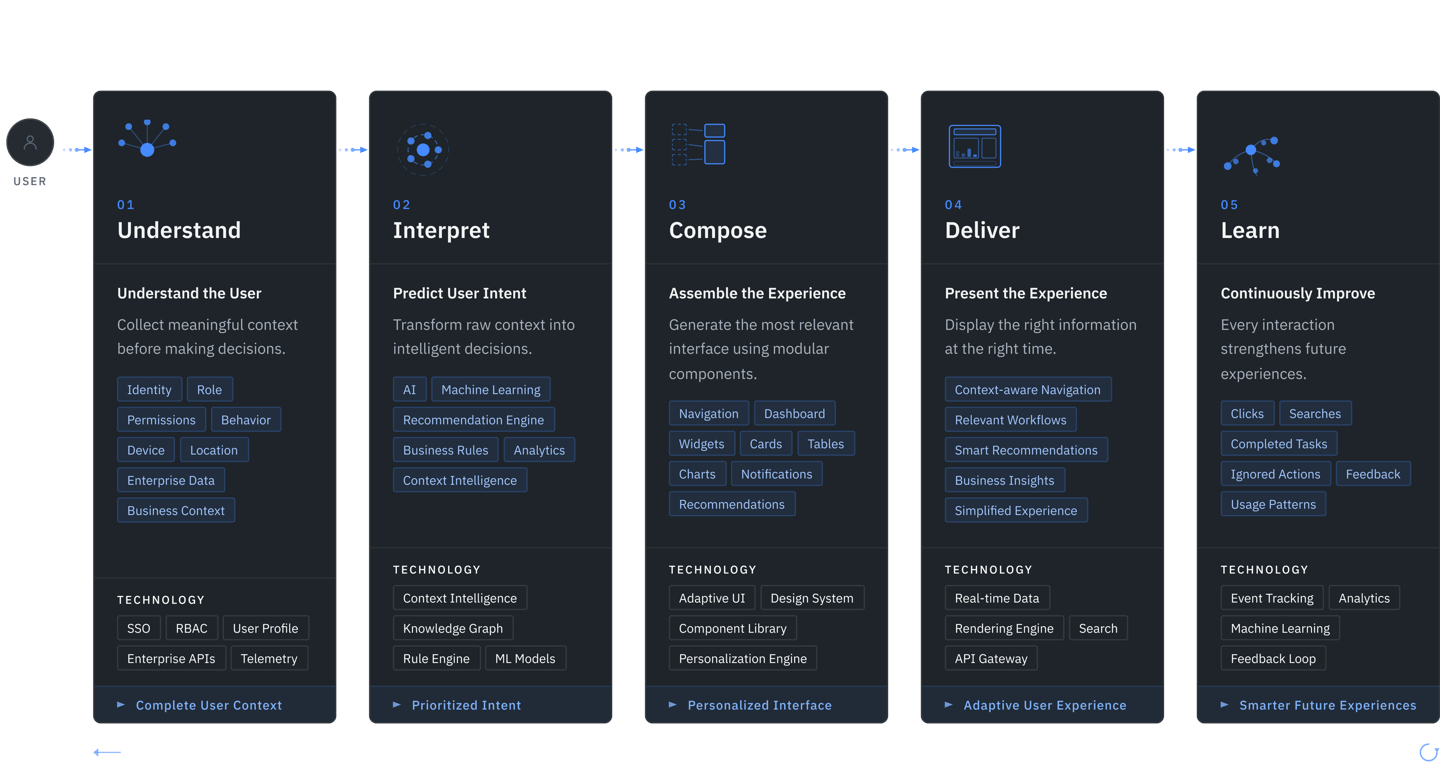
Continuous intelligence loop every interaction improves the next cycle
Identity
Behind every adaptive experience
SSO | User Profiles | RBAC
Enterprise data
APIs | ERP | CRM | HR | IoT
Experience Layer
AI | Machine Learning | Rule Engine | Analytics
Intelligence
Design System | Components | Personalization | Adaptive UI
The result
01
User uses a digital product
AEX Understands context & predicts Intent
02
03
AEX Personalizes the experience
04
User completes the business task
AEX Learns & improves future experiences
05
Platform architecture
Three layers. One adaptive system. Built to scale.
Each layer handles a distinct part of the experience discovery, real-time adaptation, and continuous learning designed to work independently but compound together as the platform grows.


Built on IBM Carbon principles with a scalable token architecture designed to support new products, domains, and experiences without losing consistency.
Designing for scale

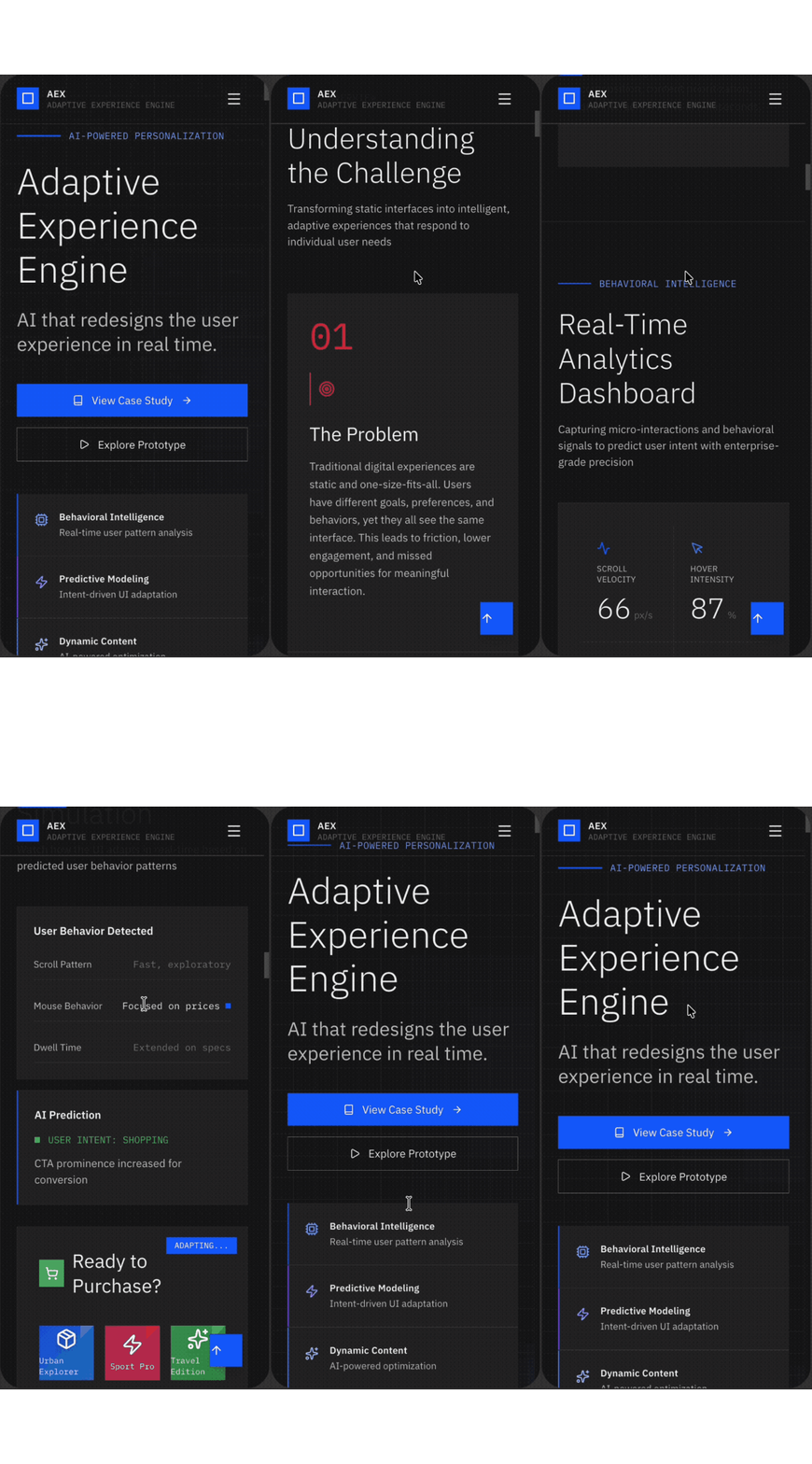
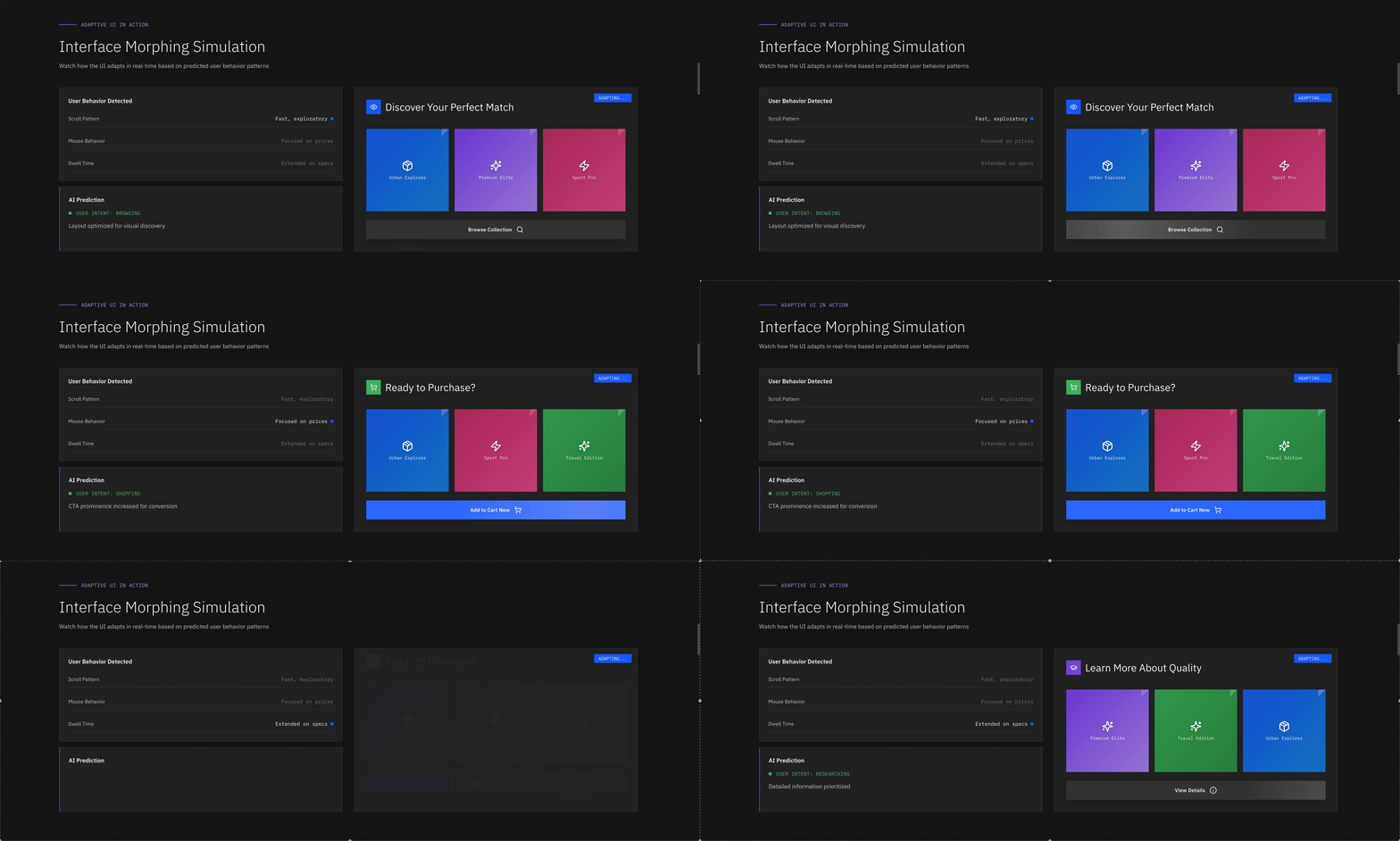
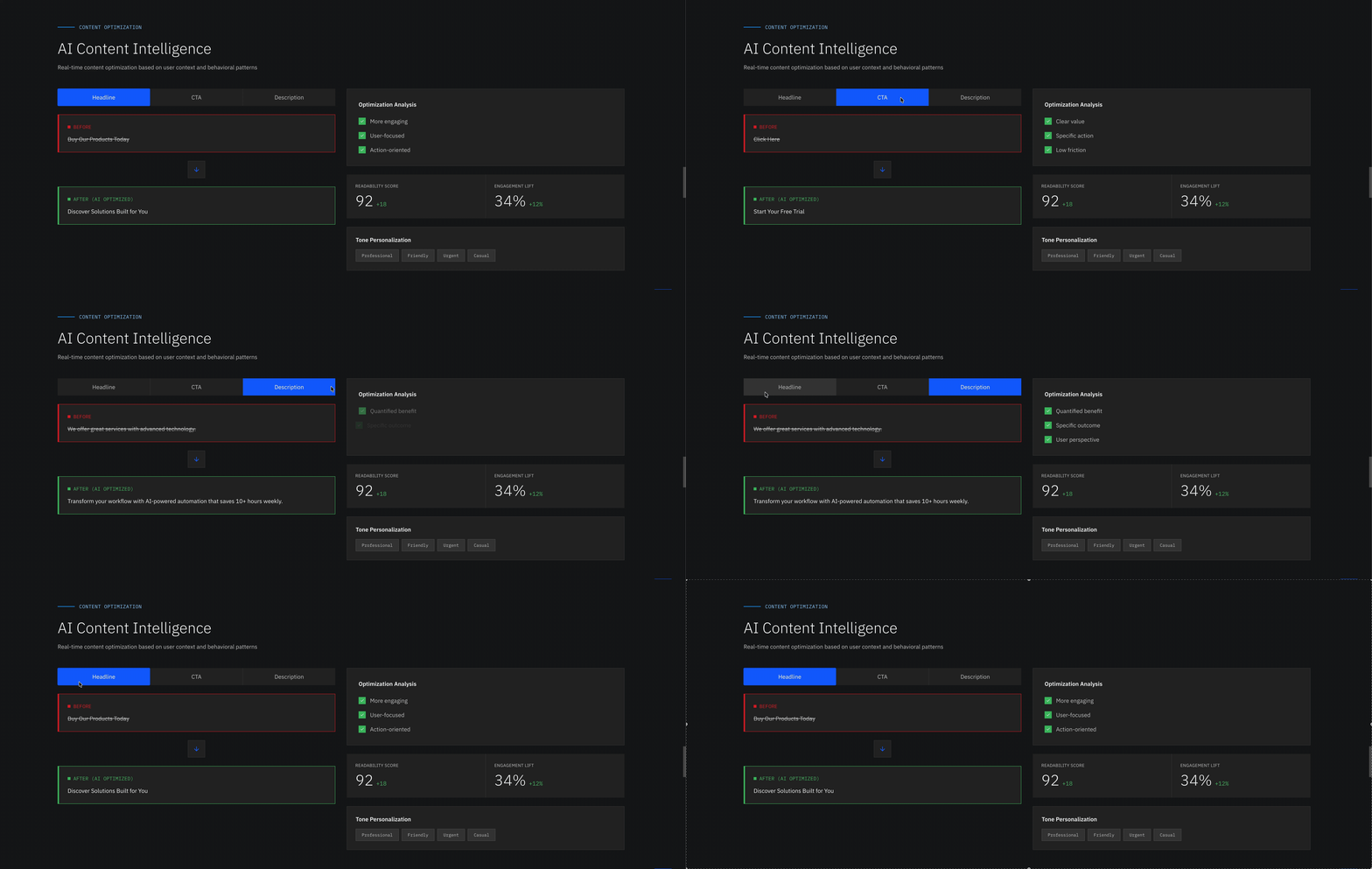
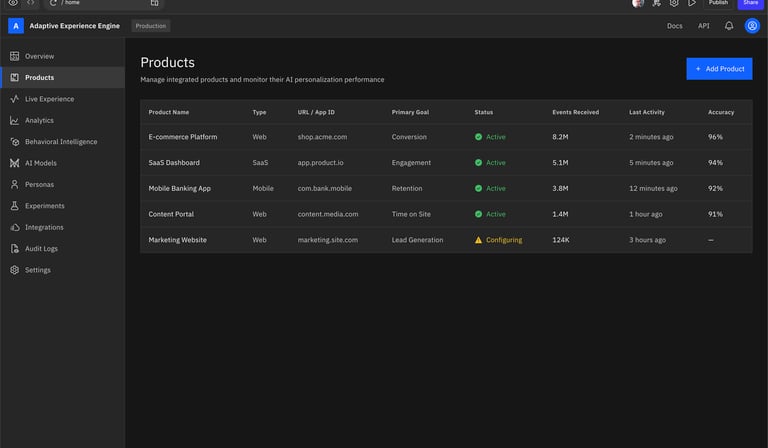
Adaptive experiences in action
Real-time personalization, behavioral intelligence, and analytics working together as a unified platform.
Mobile adaptive experience
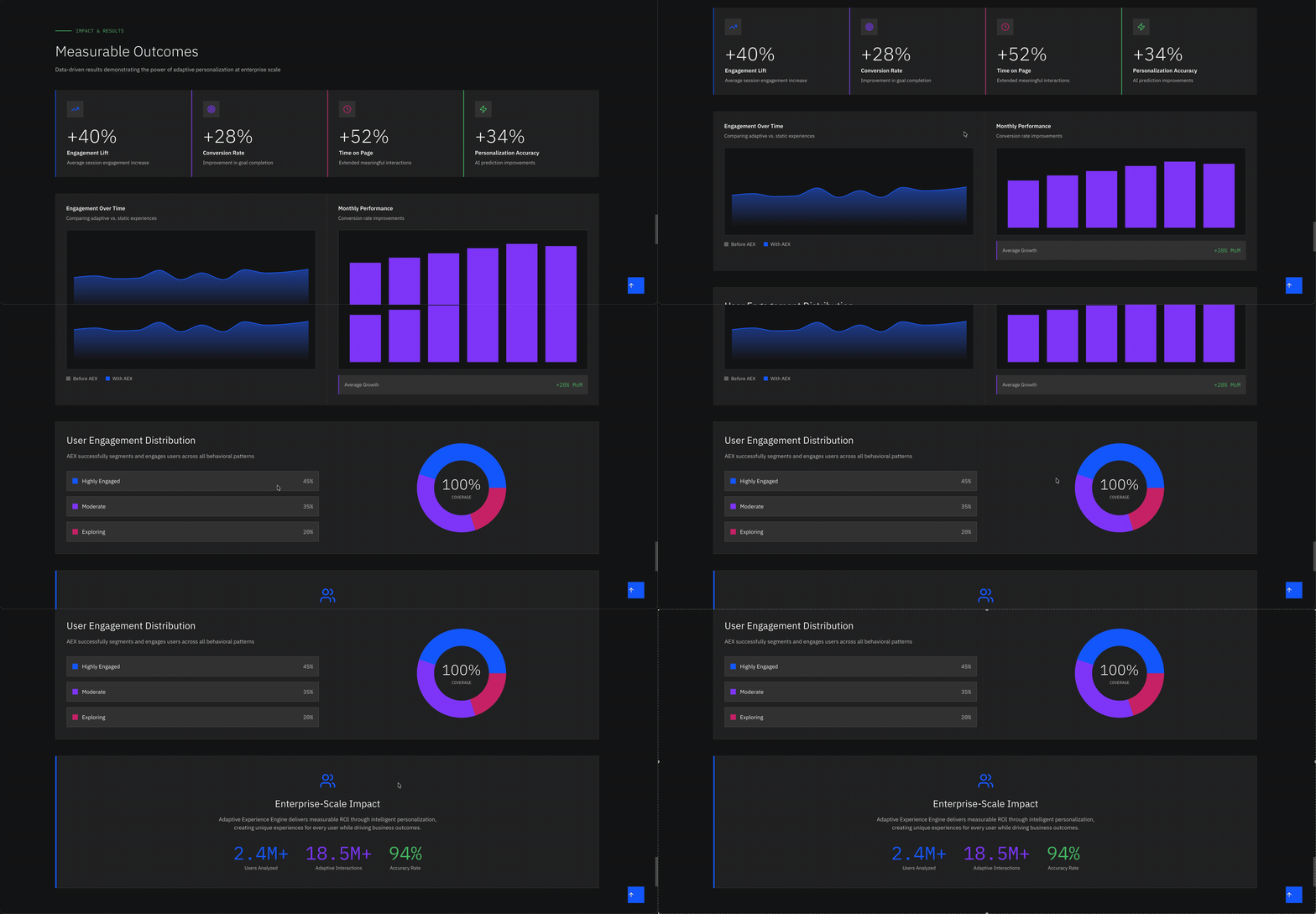
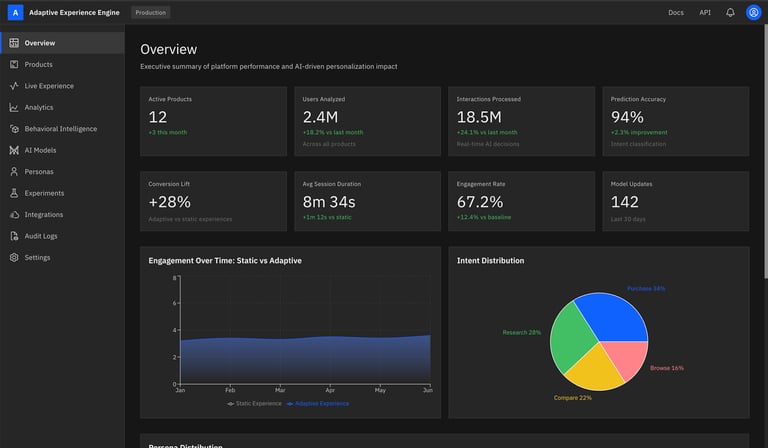
Performance and impact
Sample metrics illustration UI, not measured results.
The product, as it is being built.
WIREFRAMES CONCEPT